
Bamboo-leaf oak (Quercus myrsinifolia): https://en.wikipedia.org/wiki/Quercus_myrsinifolia
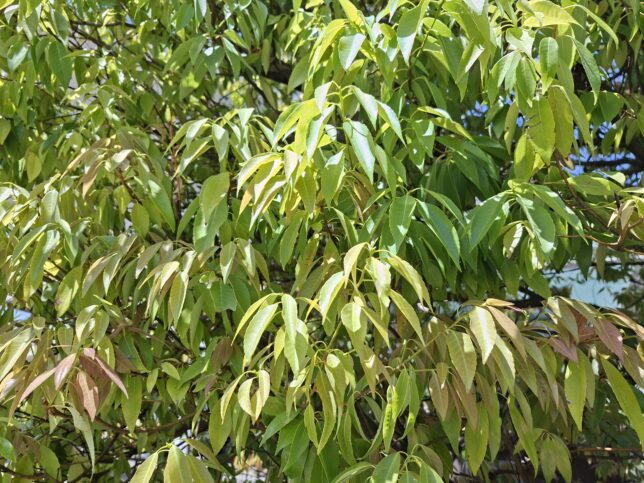
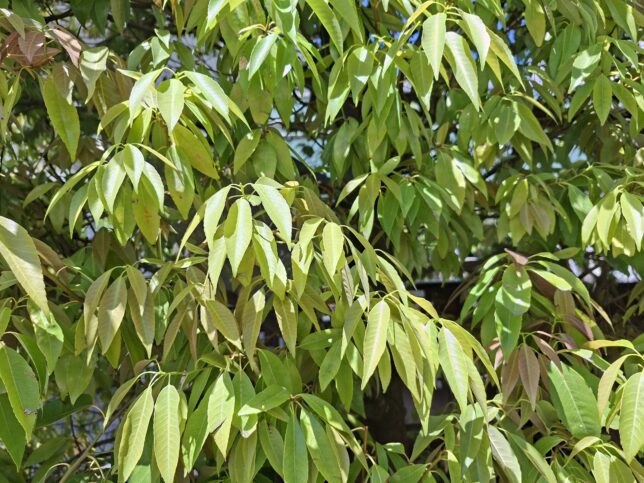
Bamboo-leaf oak trees, Kofu, Yamanashi, 5/10/2026
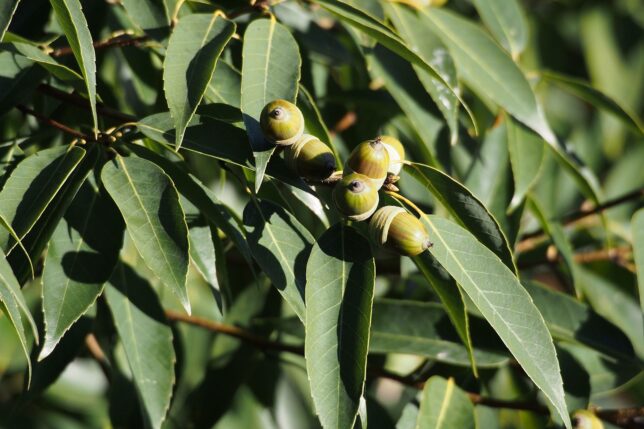
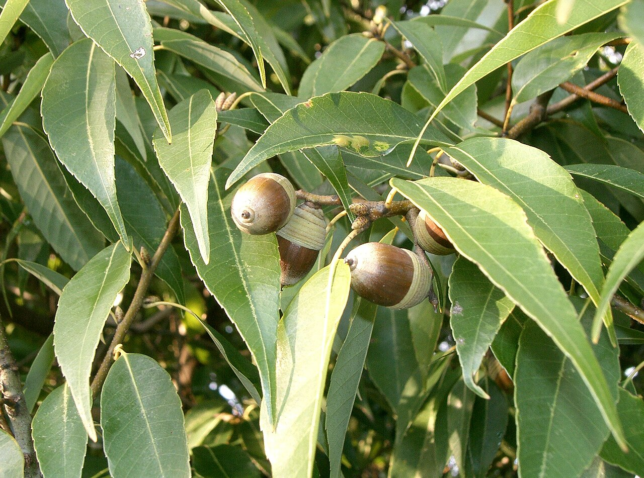
Acorns of one species (Quercus myrsinifolia): https://en.wikipedia.org/wiki/Quercus_myrsinifolia
Acorns as a Source of Valuable Compounds for Food and Medical Applications: https://www.mdpi.com/2076-3417/14/7/2799; Acorn https://en.wikipedia.org/wiki/Acorn and https://simple.wikipedia.org/wiki/Acorn
List of Quercus species:
https://en.wikipedia.org/wiki/List_of_Quercus_species
Tama Dongurinokai, from approaching nature around us to studying ecological economics: https://www.meiji-sdgs.jp/en/articles/efforts/2633/
Identification of the acorns summarized using the information identified by the Google AI:
Acorns, produced by trees in the genus Quercus (along with Notholithocarpus and Lithocarpus), are broadly divided into white oak (one-season maturity, low tannin) and red oak (two-season maturity, high tannin) groups. These nuts are vital for wildlife and vary significantly in shape, size, and cap structure.
Here are 24 distinct species of oak trees known for their characteristic acorns, featuring a mix of common and distinct types:
White Oak Group (1-Season Maturation, Low Tannin)
- White Oak (Quercus alba): Features long, oblong-shaped acorns with a warty, shallow bowl-shaped cap.
- Bur Oak (Quercus macrocarpa): Produces some of the largest acorns, distinguished by a heavily fringed or “hairy” cap that can cover most of the nut.
- Swamp White Oak (Quercus bicolor): Often found in pairs, these acorns are long-stalked and light brown.
- Swamp Chestnut Oak (Quercus michauxii): Known as “cow oak,” this species produces large, sweet acorns highly prized by wildlife.
- Chinkapin Oak (Quercus muehlenbergii): Produces small, chestnut-brown acorns that are sweet and quickly consumed by animals.
- Post Oak (Quercus stellata): Characterized by small acorns with thick, chunky caps that cover one-third to half the nut.
- Chestnut Oak (Quercus montana): Features large, shiny, elongated acorns that are among the first to drop in autumn.
- Over-cup Oak (Quercus lyrata): Famous for a unique, nearly enclosed, globular acorn covered by a scaly, “cupped” cap.
- Live Oak (Quercus virginiana): Produces small, dark, shiny, football-shaped acorns typically found in clusters.
- Blue Oak (Quercus douglasii): Native to California, this species produces acorns with very thin, shallow caps, which are a major food source in xeric environments.
- Oregon White Oak (Quercus garryana): Known for large, oval acorns with a small, warty cap, common in the Pacific Northwest.
- Dwarf Chestnut Oak (Quercus prinoides): A shrub-like oak producing small, thin-shelled acorns that mature quickly.
Red Oak Group (2-Season Maturation, High Tannin)
- Northern Red Oak (Quercus rubra): Features large, rounded acorns with a flat, saucer-like cap that covers only the top, often described as a “beret”.
- Black Oak (Quercus velutina): Produces acorns with a distinct, “shaggy” cap covering about half the nut, known for its orange inner bark.
- Pin Oak (Quercus palustris): Small, round, striped acorns with a very thin, small cap.
- Scarlet Oak (Quercus coccinea): Features acorns with concentric rings on the tip and a cap that often tapers.
- Water Oak (Quercus nigra): Produces very small, nearly spherical acorns with a shallow cap, which often appear in huge quantities.
- Willow Oak (Quercus phellos): Known for very tiny, light brown acorns with shallow caps, which are a favorite for deer and ducks.
- Southern Red Oak (Quercus falcata): Small, rounded acorns (approx. 1/2 inch) that are orange-brown in color.
- Shingle Oak (Quercus imbricaria): Produces small, bitter acorns, often with a striped appearance on the nut, with a cap covering up to a third.
- Turkey Oak (Quercus cerris): A European species featuring a very distinctive mossy or bristly cupule (cap).
- Cherry-bark Oak (Quercus pagoda): Known as part of the red oak group, its small, 1/2-inch wide acorns are a favorite for fall hunting.
- Shumard Oak (Quercus shumardii): Produces large, stout, somewhat oblong acorns with a relatively shallow, scaly cap.
- Nuttall Oak (Quercus nuttallii): Produces large, elongated, striped acorns that fall late in the season.
Key Identification Features
- Cap Scales: Red oak caps have tight, overlapping scales, while White oak caps can be warty or bumpy.
- Maturation: Red oak acorns take two years; white oak acorns take one.
- Interior: White oak shell interiors are smooth; Red oak shell interiors are fuzzy.
- Taste: White oak acorns are sweeter (less tannin); Red oak acorns a very bitter.
Quick Identification Table
| Feature | White Oak Group | Red Oak Group |
|---|---|---|
| Leaf Tips | Rounded, smooth | Bristle-tipped |
| Maturation | One season | Two seasons |
| Cap Type | Bumpy/Warty | Scaly/Flat |
| Taste | Sweeter | Bitter |
| Germination | Fall (same year) | Spring (next year) |